Remote buyers begin with a deficit of context
The evaluation of remote land usually begins at a distance. The buyer is not standing on the property. They are not driving the access road, seeing the slope in person, or understanding how the site relates to nearby ridges, valleys, water, roads, structures, vegetation, or neighboring parcels.
This creates a context deficit.
Residential property is often easier to interpret online because its visual grammar is familiar. A buyer understands a kitchen, a bedroom, a facade, a driveway, a pool, or a view corridor. Even when the photography is imperfect, the object being evaluated is relatively conventional.
Land is different. The subject is not a building, but a spatial condition. Its value may depend on terrain, exposure, privacy, access, buildability, water, adjacency, outlook, recreational use, agricultural potential, or long-term development logic. These qualities are not always visible in ordinary listing photography.
A flat satellite image may show the boundary of a parcel, but not the experience of the land. Ground photographs may show fragments, but not how those fragments relate to one another. Drone shots may be attractive, but they often favor atmosphere over structural comprehension.
Remote buyers therefore begin with a basic question: what am I actually looking at?
A stronger visual presentation answers that question more directly.
Satellite imagery shows location, not understanding
Satellite imagery is useful. It can establish location, orientation, surrounding development, vegetation patterns, roads, and approximate land cover. It is often the first layer of remote review, and for some properties it may be enough to trigger initial interest.
But satellite imagery has severe limitations as a presentation medium.
It is usually not designed for real estate interpretation. It may be outdated, seasonally inconsistent, low in visual clarity, or difficult to read at the scale of a specific parcel. It often flattens terrain, weakens depth perception, and makes large properties feel abstract. Slopes, ridgelines, drainage patterns, access routes, and usable areas may exist in the data, but they do not necessarily become visible to the buyer.
For remote land, this distinction is important. Location is not the same as understanding. A buyer can know where the property is and still fail to grasp what the property is like.
This is why a parcel boundary over a satellite screenshot often feels insufficient for high-value land. It gives a geographic answer, not a property answer.
A more useful visual layer should help the viewer interpret the land: its form, its internal logic, its relationship to access, and its broader setting.
The buyer needs to build a mental model
Serious property evaluation is not only a matter of exposure. It is a matter of mental modeling.
Before a buyer visits a remote site, they need to assemble a working understanding of the property. This does not need to be complete. It does need to be coherent enough to justify attention, questions, travel, or deeper review.
For land, that mental model often includes:
- how the property is reached;
- how the terrain rises, falls, or opens;
- where the primary usable areas may be;
- how the parcel relates to surrounding roads and landscape features;
- whether the setting feels isolated, accessible, exposed, sheltered, dramatic, practical, or difficult;
- what kind of experience the property seems to support.
Ordinary listing media often gives these pieces separately. A map gives one kind of information. A satellite view gives another. Ground photos give scattered impressions. A drone video may provide movement, but not always comprehension.
The buyer is left to connect the pieces.
Better property visualization reduces that interpretive burden. It does not eliminate the need for review, but it gives the buyer a clearer starting point. The land becomes easier to remember, easier to explain, and easier to discuss with partners, advisors, investors, or family members.
Remote presentation affects the size and quality of the audience
For remote property, the practical audience is often limited by comprehension.
A local buyer may already know the terrain, the road system, the regional landscape, or the type of land being offered. A distant buyer does not. They depend more heavily on the listing’s ability to translate place into visual understanding.
This is where better presentation can materially change the early review process. Not by making unrealistic claims, and not by replacing an in-person visit, but by making the property easier to evaluate for people who are not already familiar with it.
That can matter for ranches, remote acreage, off-grid property, land with complex topography, development parcels, conservation-oriented land, or high-value sites where the buyer pool may not be purely local.
A weak listing narrows the audience to people willing to work through ambiguity. A stronger visual presentation allows more serious buyers to form an initial view of the asset without requiring immediate travel or extensive explanation from the broker.
This does not mean that every viewer becomes a qualified prospect. It means the property becomes more accessible to qualified review.
Competitive listings often look visually interchangeable
Remote land listings frequently suffer from a sameness problem.
Many listings rely on the same visual conventions: parcel boundaries, map screenshots, satellite views, drone clips, road photos, tree lines, gates, fences, open fields, hillsides, or distant views. These materials may be accurate, but they often do not produce a distinct understanding of the asset.
For the buyer, the result can be a field of similar-looking opportunities. Large acreage begins to blur. Terrain is hard to compare. The difference between one property and another becomes dependent on written claims, acreage, price, location, and broker explanation.
Presentation cannot create value where the property has none. But it can make existing value more visible.
A remote property with strong terrain, meaningful access, a compelling setting, or a distinctive relationship to its surroundings should not be visually reduced to a flat map and a few disconnected photographs. If the land has structure, the presentation should help reveal that structure.
This is especially true when the property is expensive, remote, unusual, or difficult to access. The harder the land is to experience casually, the more important it becomes to present it with interpretive clarity.
The role of terrain-based property visuals
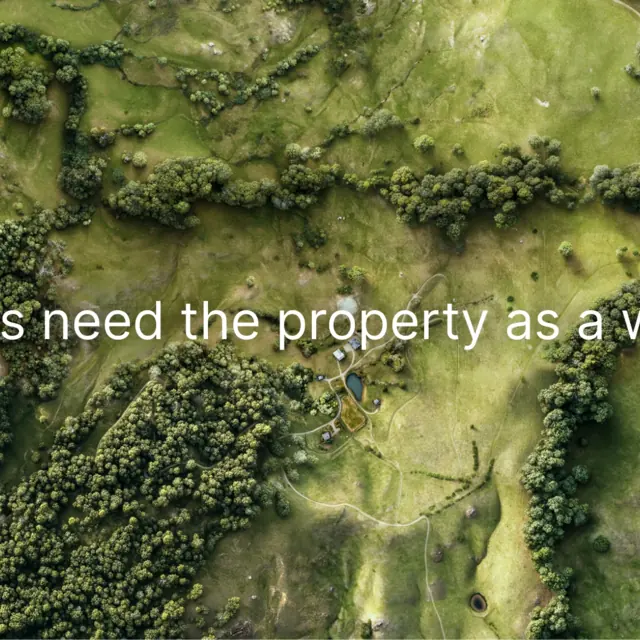
A terrain-based property visual is not a decorative rendering. Its purpose is to make the physical structure of the land more readable.
The strongest versions of this kind of visual preserve the property’s spatial relationships while improving the viewer’s ability to understand terrain, access, scale, setting, and visual character. The objective is not to make the land look more dramatic than it is. The objective is to help the property become easier to evaluate.
For a remote buyer, a well-constructed visual can clarify what ordinary media leaves ambiguous:
- the shape of the land;
- the relationship between roads and terrain;
- the presence of ridges, slopes, valleys, flats, or open areas;
- the broader landscape context;
- the difference between visually important and visually incidental areas;
- the property’s internal hierarchy.
This is a presentation layer, not an engineering document. It should be credible, restrained, and connected to source material. It should not invent the property. It should help the viewer read it.
That distinction is central. In serious real estate presentation, visual refinement must remain tied to judgment. If the image becomes too stylized, too artificial, or too detached from the actual land, it may attract attention while weakening credibility.
Better visuals support better conversations
A clearer visual does not close a transaction by itself. It does something more practical: it improves the quality of the conversation.
When a buyer can understand the property earlier, the next questions become more specific. Instead of asking only for basic orientation, they may ask about access, seasonal conditions, utilities, easements, buildable areas, water, neighboring uses, or the logic of a potential development plan. The discussion moves from “what is this?” toward “is this right for my purpose?”
For brokers and landowners, that shift matters.
The goal is not more superficial interest. The goal is more informed attention. A strong visual presentation can help filter curiosity from serious review by giving buyers enough context to understand whether the property deserves further time.
This is especially useful for remote listings, where every site visit requires effort. Travel time, scheduling, broker availability, and buyer commitment all raise the cost of vague interest. The more clearly a buyer understands the land before visiting, the more productive the visit can become.
A stronger presentation layer for remote land
Remote land needs better visual presentation because the asset is often too spatially complex to be understood through conventional listing media alone.
Maps, satellite imagery, drone photography, ground photos, and written descriptions all have value. But they frequently remain fragmented. They show parts of the property without fully explaining how those parts relate.
A more advanced presentation layer can bring those fragments into a clearer visual form. It can help the buyer understand terrain, scale, access, setting, and property character before deeper review begins.
This does not make the decision for the buyer. It gives the buyer a more reliable basis for deciding whether the property deserves attention.
For high-value land, that is the practical role of visual clarity: not spectacle, not exaggeration, but a better first understanding of place.
For presentation-use limits and source context, see legal and data source notes.