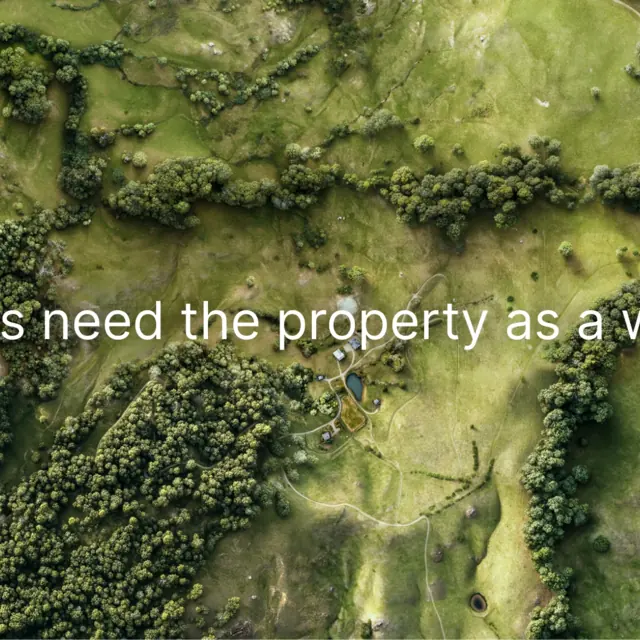
listings still rely on disconnected media
The standard listing format was built around inventory. It gives the buyer enough information to identify, compare, and inquire. That structure works tolerably well when the property is self-explanatory, the market is local, and the buyer already understands the surrounding geography.
But high-value land often requires a different kind of explanation.
A satellite image may show the parcel from above, but flatten the terrain. A drone video may create atmosphere, but leave the viewer uncertain about access or scale. Ground photography may reveal a road, fence, meadow, ridge, or water feature, but fail to show where each element sits within the whole. A map may clarify boundaries, but say little about visual character or practical experience.
The problem is not that these media types are useless. The problem is that they remain separated. They describe the property in partial views, each using a different visual language. The buyer must translate between them.
For serious review, this translation matters. If the viewer cannot connect the map to the photographs, the terrain to the access road, or the parcel boundary to the surrounding setting, the listing remains visually incomplete.
visual context is not decoration
Visual context is not the same as making a listing more attractive.
A decorative image asks the viewer to feel interest. A contextual image helps the viewer understand relationships. It shows how parts of the property belong together: where access enters, how landform changes across the site, how open areas relate to slopes or ridges, how the parcel sits within a larger landscape, and why certain areas matter more than others.
This distinction is important for premium real estate presentation.
A stronger visual presentation should not obscure the property beneath mood, exaggeration, or style. It should make the property more readable. The image may be refined, composed, and presentation-ready, but its purpose is still interpretive. It should reduce ambiguity rather than produce spectacle.
For land, context is often the missing layer. The buyer is not only asking what the property looks like. They are asking what kind of place it is, how it can be approached, what it may support, and whether it deserves a site visit or deeper analysis.
The best listing media helps that judgment begin earlier.
the next listing layer will be interpretive
Real estate listings have already absorbed several waves of visual expansion: better photography, drone footage, virtual tours, floor plans, map layers, video, and increasingly AI-assisted imagery. But more media does not automatically create better understanding.
The more useful shift is from accumulation to interpretation.
An interpretive listing layer does not simply add another asset to the page. It clarifies the relationship between existing information. For land and complex property, this may include terrain-based visuals, advanced property orthophotos, drone-like property views, contextual diagrams, annotated imagery, or presentation graphics built from source data and visual judgment.
The purpose is not to replace the original evidence. It is to make the evidence easier to read.
This is especially relevant when the audience includes remote buyers, investors, development teams, family offices, or advisors who need to understand the property before visiting. These viewers may be willing to study a serious opportunity, but they need a more coherent starting point than disconnected media can usually provide.
In that sense, the future listing becomes less like a gallery and more like a controlled presentation layer.
land will expose the weakness of ordinary listing formats first
The limitations of conventional listing media are most visible where the property is least self-evident.
A condominium can usually be explained through rooms, finishes, building amenities, and neighborhood. A house can be shown through exterior, interior, plan, and site. Land does not offer the same immediate structure. It must be interpreted through terrain, scale, access, orientation, and use potential.
This makes land a natural category for more advanced visual presentation.
Remote land, ranches, large acreage, mountain property, coastal parcels, agricultural land, and development sites often contain value that is difficult to photograph directly. A road may matter more than it looks. A slope may define the property’s usability. A ridge may explain the view. A flat area may be commercially important. A neighboring parcel, water feature, or access corridor may change the entire reading of the site.
Ordinary media can show pieces of this. It rarely organizes them into a unified visual understanding.
As buyers become more comfortable reviewing property remotely, this weakness becomes more consequential. The listing has to carry more of the early explanation. It must give the viewer enough spatial confidence to move from casual interest to serious inquiry.
AI will matter, but only inside a controlled standard
AI will inevitably influence the future of real estate listings. The relevant question is not whether AI can produce property images. It can. The question is whether those images remain credible, specific, and useful for serious evaluation.
Uncontrolled AI output can lower the standard quickly. It can beautify a property while weakening trust. It can introduce unrealistic lighting, distorted geography, invented vegetation, misleading scale, or a visual atmosphere that feels detached from the asset being sold.
For premium real estate, this is not a minor risk. A listing visual has to persuade, but it also has to withstand scrutiny. The image should help the buyer understand the property, not wonder what has been fabricated.
The more durable role of AI is therefore not one-click enhancement. It is controlled assistance within a disciplined production process: source imagery, terrain structure, property context, real estate judgment, manual refinement, and presentation standards working together.
The strongest future listings will not be those with the most obviously artificial imagery. They will be those where technical tools make the property more intelligible while preserving restraint.
visual context supports better pre-visit review
The site visit will remain important. For serious land acquisition, no visual presentation can replace walking the land, driving the access route, understanding the physical conditions, reviewing title, studying utilities, checking legal constraints, and performing proper due diligence.
But the quality of the pre-visit stage can improve.
Before a buyer visits, they need to decide whether the property deserves time, travel, attention, and deeper inquiry. That decision depends partly on price and location, but also on comprehension. If the property is visually obscure, the buyer may hesitate even when the underlying asset is strong.
Better visual context helps the buyer form a more complete first reading. It can clarify terrain, scale, setting, and access before the more formal review begins. It can also make conversations with brokers, partners, investors, or family members more precise because everyone is looking at a clearer representation of the same property.
This is not only a matter of presentation quality. It is a matter of decision quality.
the listing as a serious presentation object
A listing is often treated as a distribution container: a place to publish photos, facts, price, location, and contact information. That view is becoming too limited for complex property.
For high-value land, the listing has to act more like a serious presentation object. It should be structured enough to guide interpretation. It should respect the intelligence of the buyer. It should provide visual clarity without overexplaining, and it should make the property easier to discuss without overstating certainty.
This requires a different standard from ordinary image enhancement.
The question is not only whether the listing looks polished. The question is whether it helps the buyer understand the asset more accurately. Does it explain the land’s form? Does it show the relationship between terrain and access? Does it clarify what matters? Does it support remote review? Does it make the property easier to remember and compare?
A future listing that answers these questions well will have an advantage over one that simply adds more photographs.
from exposure to understanding
The real estate listing has historically been a mechanism of exposure. It puts the property in front of the market.
For many categories, exposure remains the central problem. For complex property, especially land, exposure is not enough. The buyer must understand what is being exposed.
This is the significance of visual context. It shifts the listing from display toward interpretation. It does not turn marketing into due diligence, and it does not make the decision for the buyer. It creates a clearer first encounter with the property.
That is a more serious direction for real estate presentation.
Not more noise. Not more visual effects. Not a larger pile of media assets.
A better reading of the place.
For presentation-use limits and source context, see legal and data source notes.