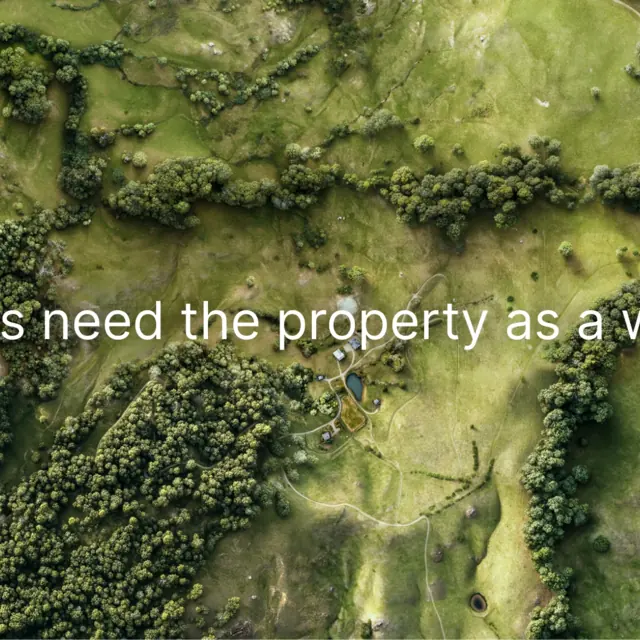
satellite imagery flattens the property into a pattern
Satellite imagery is usually the first visual layer of land evaluation. It provides orientation. It shows the parcel’s position within a broader geography. It can reveal roads, tree cover, neighboring development, open areas, water, and large-scale land use patterns.
But satellite imagery is a poor instrument for explaining the lived structure of a property.
At listing scale, satellite views often turn land into an abstract pattern: roads, shadows, irregular vegetation, exposed soil, roof shapes, and terrain marks flattened into a single overhead image. What should be a spatial condition becomes a surface texture. The buyer sees marks, but not always meaning.
A road becomes a pale line. Vegetation becomes a green mass. Slope becomes a vague change in tone. Access becomes hard to distinguish from incidental tracks. Usable land may be visually indistinguishable from difficult land. The parcel may be visible, but its internal logic remains unclear.
This is not a failure of satellite data. It is a limitation of using satellite imagery as a presentation layer.
Satellite imagery shows that something is there. It does not necessarily explain what kind of place it is.
the parcel boundary is not a visual argument
Many land listings rely heavily on the parcel outline. The boundary is useful. It tells the buyer what is being offered and gives the listing a legal or geographic frame. But a boundary is not an explanation.
A parcel line does not show the hierarchy of the land. It does not distinguish access from obstacle, usable area from visual backdrop, ridge from drainage, open ground from dense cover, or valuable setting from incidental surroundings. It marks ownership, not experience.
This distinction matters because buyers often confuse visibility with understanding. Seeing the outline of the property can create the impression that the land has been adequately shown. In reality, the most important questions may remain unanswered.
How does the property work spatially? Where does it open? Where does it close? What makes it memorable? What areas matter? What is difficult to understand from the ground? What is difficult to understand from above?
The boundary cannot answer these questions on its own. It needs to be supported by a more interpretive visual layer.
drone footage is often treated as a checklist item
Drone photography and video can be powerful. When planned with intent, a drone can show approach, scale, relationship to surroundings, topography, view corridors, and the visual character of a property. In many cases, it is the most intuitive way to give a buyer a first sense of place.
But in ordinary listing practice, drone footage is often treated less as a storytelling tool and more as a requirement to be checked off.
The drone is sent up. A few sweeping shots are captured. The property is shown from a pleasing angle. A road, house, field, ridge, or tree line passes through frame. The footage looks modern enough to include in the listing, but it does not necessarily explain the asset.
The problem is usually not the existence of drone media. The problem is the absence of visual direction.
A drone shot without a clear interpretive purpose can become atmosphere without structure. It may look impressive while leaving the buyer uncertain about access, orientation, usable areas, terrain, or the relationship between one part of the property and another. It can create motion without comprehension.
For high-value land, that is a weak use of a potentially strong medium.
drone media is constrained by the conditions of capture
Drone work is also limited by practical conditions.
A small drone with a modest camera may produce footage that looks thin, noisy, compressed, or visually unstable. Flight altitude, lens quality, sensor size, weather, wind, haze, vegetation condition, time of day, and legal flight restrictions all shape what can be captured. The operator may have limited time on site. The terrain may be difficult to access. The best viewpoint may not be available. The most important visual relationships may not become clear during the flight.
Height is another constraint. Too low, and the drone shows fragments without enough context. Too high, and the property begins to resemble satellite imagery, losing depth, atmosphere, and interpretive hierarchy. The useful middle ground depends on planning, technical quality, and the specific logic of the site.
This is why drone footage often underperforms in land listings. It is not because aerial media is ineffective. It is because a single flight day is a narrow foundation for explaining a complex property.
The drone captures what was possible under those conditions. The listing still needs to explain what matters.
ground photography shows fragments, not the whole
Ground photography has a different limitation. It can show material detail, atmosphere, texture, vegetation, roads, structures, views, and the feeling of being on the land. It can be emotionally important because it gives the buyer a human-scale point of contact.
But ground photography struggles with spatial continuity.
A road photo may show access but not where that access leads. A view photo may show outlook but not the terrain behind the camera. A meadow, ridge, tree line, or creek may look compelling in isolation while remaining disconnected from the rest of the property. The buyer receives impressions, but not always orientation.
This becomes more difficult when the land is remote, large, topographically complex, or visually repetitive. Ground images may be accurate and still fail to explain the whole.
The issue is not that ground photography should disappear. It should not. The issue is that it needs to sit inside a clearer visual system. Without that system, it becomes a sequence of fragments the buyer must assemble alone.
photographers are not always available when the property needs explanation
A conventional media strategy assumes that photography can be arranged when needed: send a photographer, schedule the shoot, capture the property, edit the images, and publish.
That assumption does not always hold for land.
The property may be remote. Access may be difficult. Weather may interfere. Seasonal conditions may be wrong. The best visual moment may not align with listing timelines. Drone permissions may be complicated. Roads may be rough. The owner or broker may not have the budget, time, or logistical capacity to produce a full media package on site.
In some cases, bringing a photographer is simply inefficient. In others, it is possible but incomplete. A photographer can capture what is visible during a specific visit, but may not be able to produce the broader interpretive context the listing requires.
For high-value land, this creates a gap between the importance of presentation and the practical limits of capture.
The property still needs to be explained. The listing still needs a coherent visual account. But the traditional production model may not provide one.
the deeper problem is discontinuity across media
The greatest weakness of ordinary land listings is not any single media type. It is discontinuity.
The satellite image speaks one visual language. The parcel map speaks another. Drone footage speaks another. Ground photographs speak another. The written description may emphasize features that are hard to find visually. The brochure may arrange everything in a polished way without resolving the underlying lack of spatial coherence.
The buyer is left to connect all of it.
For some viewers, this is manageable. For many remote buyers, investors, or exploratory land buyers, it is not. The property becomes visually unstable. It appears differently in each medium, with no controlling point of view. The land may be interesting, but the listing does not make that interest easy to understand.
A serious property presentation should preserve continuity. It should help the buyer move from overview to detail without losing orientation. The same terrain, access logic, surrounding context, and visual character should remain recognizable across media.
This is where a controlled visual system becomes valuable.
terraxis treats land presentation as a visual explanation problem
Terraxis approaches land media differently because the task is not simply to produce attractive images. The task is to make the property readable.
That requires a more controlled process: source imagery, terrain structure, parcel context, mapping information, property-specific references, AI-assisted generation, manual refinement, and real estate judgment working together. The aim is not to replace all existing media. The aim is to create a stronger visual layer that organizes the property’s spatial and environmental logic.
This matters because Terraxis is not tied to one drone flight, one weather window, one camera, or one set of ground photographs. When adequate source material exists, the property can be reconstructed into a clearer presentation system: advanced property orthophotos, terrain-based property visuals, drone-like property views, contextual imagery, and refined presentation assets that share a coherent visual logic.
The result is not a fantasy version of the land. It should remain specific, credible, and restrained. The goal is to close the visual explanation gap: to show the property in a way that ordinary listing media often cannot.
For land, that means terrain becomes more readable. Access becomes easier to follow. Scale becomes easier to grasp. Surrounding context becomes more intelligible. The property begins to appear not as a scattered collection of media, but as a coherent place.
consistency matters more than spectacle
The strongest land presentation is not the one with the most dramatic image. It is the one that gives the buyer a stable understanding of the property.
This is especially important when multiple media assets are used together. A listing may need an overview visual, a terrain-based property image, a drone-like perspective, an annotated map, close-up details, and supporting photography. If each asset feels unrelated, the buyer’s understanding weakens. If the assets share a coherent visual structure, the property becomes easier to read.
Consistency does not mean sameness. It means continuity of interpretation.
The buyer should be able to recognize the same land across different views. The visual narrative should not break between overhead imagery, oblique views, listing presentation, and supporting materials. Each piece should add clarity rather than create a new puzzle.
This is one of the practical advantages of a controlled production pipeline. It can maintain the integrity of the property’s visual story across multiple assets, rather than relying on unrelated captures assembled after the fact.
the listing should not make the buyer solve the media
A land buyer already has enough to evaluate: price, access, legal conditions, utilities, water, topography, zoning, development potential, risk, maintenance, financing, and long-term use. The visual presentation should reduce uncertainty, not add another interpretive burden.
When the listing relies on weak satellite views, unfocused drone footage, disconnected ground photographs, and thin descriptions, the buyer has to solve the media before they can evaluate the property.
That is backwards.
The listing should clarify. It should make the important spatial relationships visible. It should help the buyer understand the property before deeper due diligence begins. It should allow a serious viewer to move from exposure to comprehension with less friction.
Satellite imagery, drone media, and photography all have a place in this process. But they are not enough when used without direction.
For high-value land, the presentation has to do more than show available visuals. It has to explain the place.
Terraxis is built for that gap: the space between raw media and a property that can be understood.
For presentation-use limits and source context, see legal and data source notes.